Lichfield Trent Valley Railway: A Historic Hub Connecting the Heart of Staffordshire
Introduction: The Significance of Lichfield Trent Valley Railway
Lichfield Trent Valley Railway stands as a vital transport artery in Staffordshire, deeply rooted in the historic development of Britain’s railway network. More than just a functional station, it’s a living monument to Victorian engineering and modern rail innovation. As part of the West Coast Main Line and the Cross-City Line, this station has long served as a key interchange for both local commuters and long-distance travelers.
This article explores the rich history, modern developments, services, and facilities associated with Lichfield Trent Valley Railway, including useful information for travelers such as parking, postcode, and station layout. If you’re researching or planning a journey, here’s everything you need to know.
The Origins of Lichfield Trent Valley Railway
The Trent Valley Railway Company
The Trent Valley Railway (TVR) was formed on 21 July 1845, with the aim of building a direct rail route between Rugby and Stafford. This new route would create an important bypass to the congested Birmingham line by linking the London and Birmingham Railway (L&BR) at Rugby with the Grand Junction Railway (GJR) at Stafford.
This strategic move enhanced the overall efficiency of rail travel across the Midlands and beyond.
Official Opening in 1847
On 15 September 1847, the railway opened to the public, including the original station at Lichfield. From its earliest days, Lichfield Trent Valley Railway Station played an essential role in connecting travelers through Staffordshire. It helped place Lichfield on the national rail map, giving the city both economic and social mobility.
Evolution of Lichfield Trent Valley Railway Station
The 1871 Reconstruction
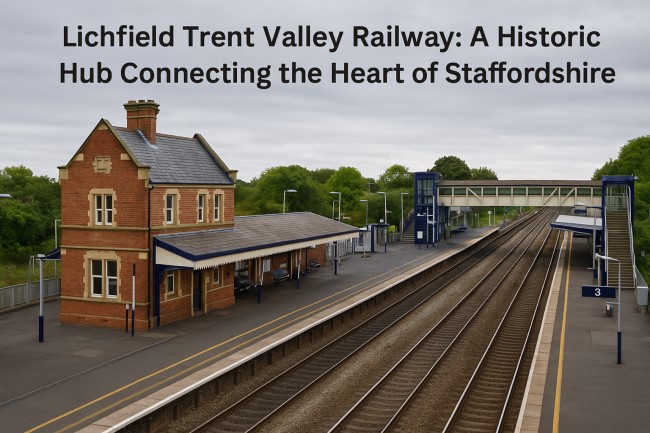
As passenger traffic increased, the original station was no longer sufficient to meet demand. In 1871, it underwent a substantial rebuild, transforming it into a more robust structure with expanded facilities. The current split-level design was implemented to allow efficient transfer between mainline and suburban services.
Integration into Major Rail Networks
Through company mergers and nationalisation, Lichfield Trent Valley Railway Station became part of larger networks, including the London and North Western Railway (LNWR) and later British Rail. Its importance only grew as it became integrated into the West Coast Main Line (WCML), one of Britain’s busiest intercity corridors.
Modern-Day Lichfield Trent Valley Railway Station
Dual-Level Station Design
Today, Lichfield Trent Valley Railway Station Lichfield features a lower level serving long-distance services on the WCML and an upper level (Platform 3) for Cross-City Line trains. This makes it a unique example of a vertically integrated railway hub.
Operators and Services
-
Avanti West Coast provides long-distance services to London, Birmingham, and Crewe.
-
West Midlands Railway (London Northwestern) offers regional services connecting Euston and Stafford.
-
The Cross-City Line, operated by West Midlands Railway, runs frequent trains between Lichfield, Birmingham New Street, and Bromsgrove/Redditch.
This blend of local and intercity services makes the station a critical interchange point for thousands of passengers each day.
Accessibility and Station Facilities
Step-Free Access and Lifts
Thanks to a £2.3 million investment in 2018–19, the station now offers step-free access to all platforms through newly installed lifts. This upgrade was part of the Access for All scheme, ensuring greater inclusivity for elderly and disabled passengers.
Waiting Areas and Amenities
-
Ticket office: Staffed during peak hours with self-service machines available.
-
Waiting rooms: Sheltered seating areas are available on all platforms.
-
Toilets: Clean facilities, including accessible options (RADAR key required).
-
Café: A small coffee outlet is located on Platform 1.
-
Free Wi-Fi and live departure screens enhance the travel experience.
Lichfield Trent Valley Railway Station Parking and Postcode
Parking Facilities
If you’re driving to the station, Lichfield Trent Valley Railway Station Parking is readily available. There are approximately 215 parking spaces, including dedicated disabled bays and EV charging stations. It operates 24/7 and holds the Park Mark award, indicating a high level of safety and maintenance.
Parking fees vary, but daily and monthly passes can be purchased for convenience. Spaces can fill up quickly during weekdays, so early arrival is recommended for commuters.
Postcode and Location
The postcode for Lichfield Trent Valley Railway Station is WS13 6HE. It is situated on Station Approach, just off Burton Road, to the northeast of Lichfield city centre. The location is easily accessible by car, bus, bike, or even on foot from nearby residential areas.
Notable Events and Historical Incidents
The 1946 Rail Crash
On 1 January 1946, the station witnessed a tragic event when a signalling fault led to a collision between two trains. 20 lives were lost, and dozens were injured. This disaster prompted improvements in railway signalling and operational safety, leaving a lasting legacy in British rail history.
Ongoing Modernisation
Platform 3 Rebuild in 2023
In late 2023, Platform 3 was entirely reconstructed at a cost of over £5.8 million. The improvements included:
-
Better shelter and seating
-
Enhanced safety systems
-
New information screens
-
Improved drainage and lighting
This project reinforced the station’s capability to handle increased passenger volumes, especially as the Cross-City Line continues to grow in popularity.
Why Lichfield Trent Valley Matters Today
Lichfield Trent Valley Railway is more than just a station. It serves as a vital multimodal interchange, a heritage site, and a gateway to the Midlands. With its efficient services, modern amenities, and historical importance, it plays a key role in the UK’s railway ecosystem.
From long-distance travelers heading to London or the North West, to local commuters boarding the Cross-City Line, the station supports a diverse passenger base every day. As railway demands evolve, so too does this historic station—adapting while preserving its legacy.
Conclusion: The Timeless Role of Lichfield Trent Valley Railway
Whether you’re planning a commute, interested in railway history, or simply exploring Staffordshire’s transport infrastructure, Lichfield Trent Valley Railway Station offers a perfect blend of heritage and modern efficiency. From its 19th-century roots to its 21st-century upgrades, it continues to be a cornerstone of British rail travel.