Joyce Banda: Biography, Presidency, Foundation, Family, Net Worth and Latest 2026 Update
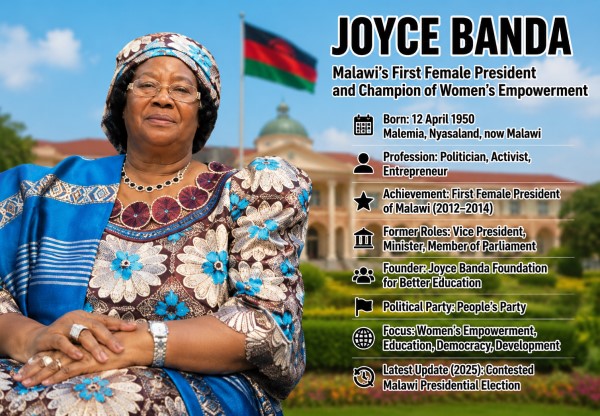
Table of Contents
ToggleIntroduction
Joyce Banda is one of the most respected female political figures in Africa. She is best known as the first woman to serve as President of Malawi and one of the most influential voices for women’s empowerment, education, and social development on the continent. Her journey from a women’s rights activist and entrepreneur to Malawi’s highest political office is both historic and inspiring.
Born on 12 April 1950 in Malemia, Nyasaland, now Malawi, Joyce Hilda Banda built her public identity through community service before entering national politics. Her work has focused on helping women become economically independent, supporting vulnerable children, improving education, and promoting democratic leadership.
In 2025, Joyce Banda returned to Malawi’s political spotlight as a presidential candidate in the country’s general election. Although she did not win, her continued participation showed that she remains an important figure in Malawian politics and African leadership.
Quick Bio of Joyce Banda
| Field | Details |
|---|---|
| Full Name | Joyce Hilda Banda |
| Date of Birth | 12 April 1950 |
| Birthplace | Malemia, Nyasaland, now Malawi |
| Nationality | Malawian |
| Profession | Politician, Activist, Entrepreneur |
| Famous For | First female President of Malawi |
| Presidential Term | 2012 to 2014 |
| Former Position | Vice President of Malawi |
| Political Party | People’s Party |
| Main Focus | Women’s empowerment, education, democracy, social development |
| 2025 Update | Contested Malawi’s 2025 presidential election but did not win |
Joyce Banda Early Life and Background
Joyce Banda was born during a period when Malawi was still under colonial influence. Growing up in a society where women had limited opportunities, she saw the difficulties faced by girls, mothers, and poor families. These early experiences shaped her life mission and later became the foundation of her activism.
Her full name is Joyce Hilda Banda. She developed a strong interest in education, leadership, and community development from an early age. Unlike many political figures who begin directly in government, Banda first became known through grassroots work. She worked closely with women and families, especially those struggling with poverty, lack of education, and limited business opportunities.
Education and Personal Development
Joyce Banda has often linked education with empowerment. Her public career shows a clear belief that education can change not only individual lives but also entire communities. She has supported schooling for children and promoted leadership opportunities for women and young people.
Her educational background helped her develop communication, organisational, and leadership skills. These qualities later supported her rise in public life, from activism to ministerial roles and eventually the presidency.
Joyce Banda as an Entrepreneur and Activist
Before becoming president, Joyce Banda was already active in business and social development. She understood that many women in Malawi needed practical support, not just political speeches. For this reason, she worked to help women start small businesses, gain financial confidence, and become more independent.
Her activism focused on real-life problems such as poverty, gender inequality, domestic challenges, and lack of access to education. This made her popular among communities that wanted direct action and practical solutions.
Joyce Banda Foundation
One of Joyce Banda’s major contributions is the Joyce Banda Foundation for Better Education. The foundation has been associated with education, child welfare, community development, and support for vulnerable children.
Through this foundation, Banda strengthened her image as more than a politician. She became known as a social reformer who believed that leadership should improve ordinary people’s lives. Her work with children, women, and rural communities remains an important part of her legacy.
Entry into Politics
Joyce Banda entered Malawi’s National Assembly in 1999. Her political rise was connected to her earlier work in social development. People already knew her as a woman who supported communities, especially women and children.
Her political style focused on social justice, gender equality, human development, and democratic values. Instead of limiting her work to party politics, she often presented herself as a leader concerned with the daily struggles of citizens.
Ministerial Roles
Before becoming vice president and president, Joyce Banda served in important government positions. She worked as Minister of Gender, Child Welfare and Community Services, where she focused on issues affecting women and children.
Later, she served as Minister of Foreign Affairs. This role gave her experience in diplomacy, international relations, and national governance. These ministerial positions helped prepare her for higher leadership and increased her recognition both inside and outside Malawi.
Joyce Banda as Vice President of Malawi
In 2009, Joyce Banda became Vice President of Malawi. This was a major achievement for women in Malawian politics. At that time, female political representation was still limited in many African countries.
Her time as vice president was not without political challenges. Her relationship with the ruling leadership became difficult, and she later formed her own political platform. This showed her independence and determination to continue her political work despite pressure.
Formation of the People’s Party
Joyce Banda founded the People’s Party after political disagreements within the ruling structure. The party became her main political platform and reflected her focus on democracy, development, social justice, and economic reform.
The creation of the People’s Party showed that Banda was not only a symbolic leader but also a political organiser. She built a platform around her own ideas and continued to participate actively in national politics.
Joyce Banda Presidency
Joyce Banda became President of Malawi in April 2012 after the death of President Bingu wa Mutharika. As vice president, she was constitutionally next in line. Her rise to the presidency was historic because she became Malawi’s first female president.
Her presidency lasted from 2012 to 2014. During this period, Malawi faced serious economic problems, including fuel shortages, foreign exchange difficulties, donor concerns, and public frustration. Banda’s government worked to rebuild international trust and restore relations with development partners.
Main Focus During Her Presidency
As president, Joyce Banda focused on economic recovery, international relations, governance, women’s rights, education, and poverty reduction. She inherited a difficult economic situation, and many reforms were not easy for ordinary citizens.
Her administration tried to restore donor confidence and improve Malawi’s global image. She also continued to speak strongly about women’s empowerment and the importance of education for national development.
Cashgate Scandal and Political Challenges
One of the biggest challenges during Joyce Banda’s presidency was the Cashgate scandal. This corruption scandal involved the theft of public funds through government systems. It became a major issue in Malawi and affected public trust in government.
Joyce Banda denied personal involvement and said her administration helped expose corruption. However, the scandal damaged her political image and became one of the factors that affected her performance in the 2014 election.
2014 Election and Life After Presidency
Joyce Banda contested the 2014 presidential election but lost to Peter Mutharika. Although her presidency ended after a short period, her role in Malawi’s history remained significant.
After leaving office, she remained active in international discussions on democracy, women’s leadership, development, and good governance. She continued to be recognised globally as a former president and advocate for women’s rights.
Latest 2025–2026 Update
In 2025, Joyce Banda again became active in Malawi’s presidential race as a candidate for the People’s Party. Her decision to contest the election showed that she remained committed to national politics and still had a political base.
However, she did not win the 2025 presidential election. The election was won by former president Peter Mutharika, who returned to power after defeating incumbent president Lazarus Chakwera. Even though Banda was not successful in the race, her participation kept her relevant in Malawi’s political conversation.
As of 2026, Joyce Banda is still widely recognised as a historic female leader, former president, activist, and advocate for education and women’s empowerment.
Joyce Banda Family and Personal Life
Joyce Banda has kept many parts of her private life away from unnecessary public attention. She is known as a mother and public servant who has balanced family responsibilities with leadership, activism, and politics.
Her personal journey has often been linked with resilience. She has spoken through her life’s work about the importance of women having dignity, independence, and opportunities to make decisions about their futures.
Joyce Banda Net Worth
There is no fully verified public figure for Joyce Banda’s exact net worth. Many websites mention estimated amounts, but most of these claims are not supported by reliable financial records. Therefore, it is better to avoid giving a fixed net worth figure unless it comes from a trusted and transparent source.
What can be said safely is that Joyce Banda has built her career through politics, public service, activism, entrepreneurship, and international speaking. Her value and influence are better understood through her leadership legacy rather than unverified wealth estimates.
Joyce Banda Legacy
Joyce Banda’s legacy is strongly connected to women’s leadership in Africa. She proved that women can lead at the highest level of government and influence national direction. Her presidency encouraged many women and girls to imagine themselves in leadership roles.
Her legacy also includes work in education, child welfare, women’s economic empowerment, and democratic governance. While her political career faced criticism and challenges, her historic importance remains clear.
Why Joyce Banda Still Matters
Joyce Banda still matters because her story represents courage, persistence, and public service. She rose from community activism to national leadership at a time when African women were often underrepresented in top political positions.
Her life also shows that leadership is not only about winning elections. It is about creating opportunities, challenging inequality, and continuing to serve society even after leaving office.
FAQs About Joyce Banda
Who is Joyce Banda?
Joyce Banda is a Malawian politician, activist, and entrepreneur who served as President of Malawi from 2012 to 2014. She was the first woman to become President of Malawi.
When was Joyce Banda born?
Joyce Banda was born on 12 April 1950 in Malemia, Nyasaland, now Malawi.
What is Joyce Banda famous for?
She is famous for becoming Malawi’s first female president and for her work in women’s empowerment, education, and social development.
Was Joyce Banda a candidate in the 2025 Malawi election?
Yes, Joyce Banda contested Malawi’s 2025 presidential election, but she did not win.
What political party does Joyce Banda belong to?
Joyce Banda is associated with the People’s Party, which she founded.
What is Joyce Banda’s net worth?
Her exact net worth is not publicly verified. Any fixed figure should be treated carefully unless confirmed by a reliable source.
Conclusion
Joyce Banda remains one of the most important women in African political history. From her early work as an activist and entrepreneur to her role as Malawi’s first female president, her journey reflects courage, service, and determination.
Although her presidency faced economic and political challenges, her contribution to women’s empowerment, education, and democratic leadership remains significant. Her participation in the 2025 election also shows that she continues to be part of Malawi’s political story.
Joyce Band’s name will always be remembered as a symbol of female leadership, resilience, and public service in Africa.