Luxury Landscaping Creates Winter Access Problems Nobody Budgets For: When Beautiful Design Meets a Snow Route
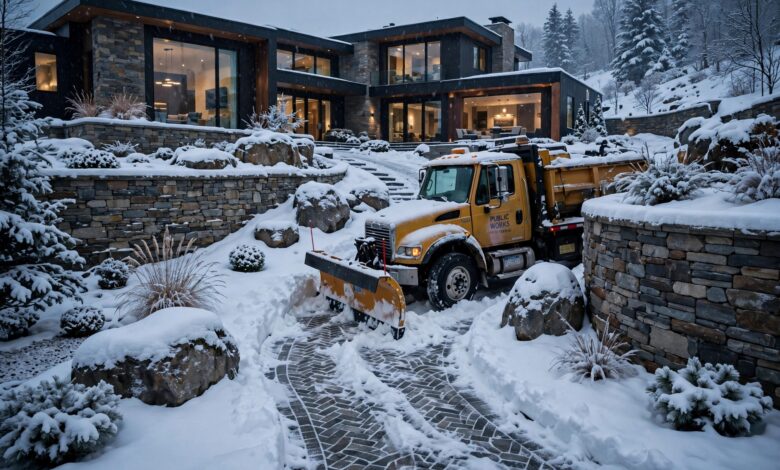
Hillside Winter Access Planning in West Vancouver
Luxury landscaping is designed to make a property feel effortless.
Stone paths curve around planting beds. Retaining walls create terraces. Low lighting defines walkways. Decorative trees soften entrances, while narrow garden connections keep vehicles away from pedestrian areas.
Then winter changes the operating rules.
Effective winter service around landscaping requires crews to work around features that were rarely designed with snow equipment in mind. A driveway that appears wide in summer may have delicate stone edging along both sides. A pedestrian route may narrow between planters. An ornamental gate can prevent mechanical equipment from reaching the next level of the property.
These details do not necessarily make the landscape poorly designed. They simply create winter constraints that may not have been included in the original maintenance budget.
For strata managers, the important question is not whether the landscaping looks complex.
It is how that complexity changes access, labour, snow storage, drainage, and the risk of accidental damage once surfaces disappear beneath snow.
Beautiful in July, Difficult in January
Snow hides the exact features crews are trying to protect.
Decorative Edges Become Invisible
Low retaining edges, lighting fixtures, irrigation components, stone borders, drainage channels, and small changes in paving material may be obvious during a preseason inspection.
Under several centimetres of snow, they can disappear.
An operator who pushes too close to an unmarked edge may damage a light fixture, disturb stonework, or strike landscaping that extends into the equipment path.
The alternative is often slower, more conservative clearing.
That may mean stopping machine work earlier and completing the remaining area manually.
For budgeting purposes, this distinction matters. A beautifully detailed entrance may contain only a modest amount of pavement but require more labour than a much larger open parking area.
Narrow Routes Reduce Equipment Options
Landscape architecture can also determine which equipment can physically reach a surface.
Steps, bollards, gates, tight curves, planters, raised beds, and narrow paths may prevent larger machines from entering.
When crews have to transition repeatedly between equipment and hand work, productivity changes.
The snow contractor is no longer clearing one continuous route. The property becomes a series of small operational zones, each with its own access limitations.
Landscape Constraints and Winter Access
The most important landscape issue is often not the feature itself but what it does to the route around it.
A planter beside an entrance may narrow the area available for snow storage. Mature shrubs can reduce visibility at a driveway exit once snowbanks begin growing. Decorative walls can prevent crews from pushing accumulation beyond a certain point.
On a tiered property, these constraints multiply.
Snow removed from an upper terrace needs somewhere to go. Moving it downhill may interfere with another walkway. Pushing it toward planted areas may damage vegetation or create runoff problems during thawing. Leaving it beside the route can gradually reduce usable width after repeated storms.
This is why winter service around landscaping should include snow-storage planning before the first event.
Managers should identify not only where snow can be pushed during the first storm, but how much capacity those locations actually provide.
A storage zone that works once may become unusable after several events.
The winter plan should anticipate what happens next.
The Hidden Cost Is Often Hand Work
Machine hours are easy to see on a snow proposal. Hand labour can be easier to underestimate.
Luxury landscapes tend to create more small surfaces: stairs, short paths, landings, decorative courtyards, narrow pedestrian connections, and entrances separated by planted areas.
Each may require shovelling, scraping, localized ice control, and careful movement around nearby finishes.
A property can therefore have relatively little total pavement while still requiring substantial labour.
The issue becomes especially important during wet coastal snow. Heavy accumulation takes longer to move manually, while repeated pedestrian traffic can compact material before crews complete every detailed area.
Managers comparing winter bids should therefore ask what the proposed service actually assumes.
Is the quoted price based mainly on machine clearing? How much hand work is included? Which decorative surfaces are excluded? What happens when snowbanks reduce access? Is relocation of accumulated snow part of the plan or an additional service?
A low seasonal number can become less attractive if the property’s most labour-intensive surfaces were never incorporated into the original scope.
Preseason Mapping and Service Documentation
A preseason walkthrough is one of the simplest ways to reduce both service confusion and property damage.
Map What Snow Will Hide
Crews should know where vulnerable features sit before winter covers them.
Photos can document low lighting, stone borders, irrigation structures, decorative curbs, steps, drainage channels, and areas where equipment clearance is limited.
Snow stakes or other appropriate markers can make important edges easier to recognize during storms.
The same walkthrough should identify preferred equipment paths and places where crews must transition to hand clearing.
That creates a practical operating map rather than forcing workers to rediscover the property’s design during poor visibility.
Document Conditions and Exceptions
GPS and photo service logs become particularly useful on complicated sites.
Only Strata Snow Removal uses both to document attendance and surface conditions. If an area cannot be serviced normally because a gate is blocked, snow storage has reached capacity, or access around a landscape feature is restricted, the exception can be recorded rather than disappearing into a generic completion note.
That documentation also helps distinguish accidental damage from pre-existing conditions.
The company’s damage repair guarantee adds another layer of accountability, but preventing damage through good planning remains preferable to repairing it afterward.
Design for Summer, Budget for Winter
Premium landscaping and reliable winter access are not incompatible.
The mistake is assuming that a property designed primarily around aesthetics will cost the same to service as an open site with simple routes and generous storage space.
Winter exposes every constraint.
Narrow passages slow crews. Decorative surfaces demand more care. Stairs increase hand work. Retaining walls restrict snow placement. Planting beds reduces available storage. Drainage paths can carry meltwater onto routes that were previously cleared.
A realistic winter budget should account for those conditions before snowfall.
Only Strata Snow Removal’s strata-only focus is useful in this context because shared residential properties frequently combine vehicle routes, pedestrian access, landscaping, multiple entrances, and limited snow-storage space within the same site.
Strict capacity limits help preserve enough crew availability for labour-intensive properties. Proactive dispatch supports follow-up when runoff or refreeze changes conditions. Large salt reserves provide resilience during prolonged ice-control events, while cancellation flexibility and documented service add practical contract transparency.
But even good operational systems cannot eliminate the physics of the site.
The strongest winter service around landscaping starts with understanding what the landscape allows crews to do safely and what it prevents them from doing quickly.
A property can be beautifully designed and still be winter-ready.
It simply has to budget for both.
Because once the snow covers the stone, lighting, planting edges, and drainage features, landscaping stops being background scenery.
It became part of the snow-removal plan.