Generative AI in Supply Chain: Enabling Resilient and Intelligent Operations
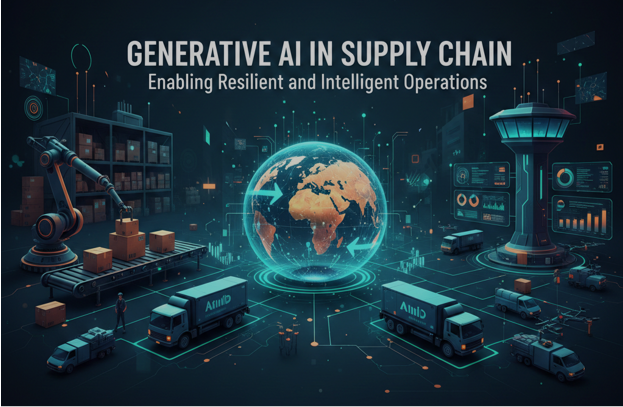
Supply chains today are operating in an environment of sustained disruption and increasing complexity. Volatile demand, geopolitical uncertainty, supplier risk, inflationary pressures, and rising customer service expectations are forcing organizations to rethink how they plan and execute supply chains. Traditional approaches built on static forecasts and rule-based decision-making are no longer sufficient to manage this level of variability.
At the same time, supply chain leaders are under pressure to improve resilience, reduce costs, and unlock productivity while supporting enterprise growth objectives. This has elevated the supply chain from a back-office function to a strategic enabler of business performance.
Generative AI is emerging as a critical capability in this transformation. By synthesizing large volumes of internal and external data and generating contextual insights, generative AI helps organizations move from reactive execution to proactive, intelligence-driven supply chain management.
Overview of Gen AI in the supply chain
Generative AI refers to a class of advanced artificial intelligence models that can generate text, insights, scenarios, and recommendations by learning patterns from vast datasets. In supply chain environments, these models ingest data from enterprise systems such as ERP, advanced planning tools, warehouse management systems, and transportation platforms, as well as unstructured data from contracts, supplier communications, market signals, and risk feeds.
Unlike traditional analytics, which rely on predefined queries and dashboards, generative AI enables natural-language interaction and adaptive analysis. Supply chain professionals can ask complex questions, explore alternative scenarios, and receive synthesized responses that consider multiple constraints and objectives simultaneously.
As organizations evaluate Gen AI in Supply Chain, the emphasis is shifting from experimentation to scalable value creation. Leading enterprises are embedding generative AI into core supply chain processes to enhance planning accuracy, improve responsiveness, and support faster, more informed decisions across the end-to-end value chain.
Importantly, generative AI does not replace existing planning and execution systems. Instead, it augments them by improving insight quality, reducing manual effort, and enabling more effective human decision-making.
Benefits of Gen AI in the supply chain
Faster and higher-quality decision-making
Supply chain decisions often require balancing cost, service, and risk under time pressure. Generative AI accelerates this process by synthesizing data across functions and presenting clear, contextual recommendations. Decision-makers can quickly understand trade-offs and act with greater confidence.
By explaining the rationale behind recommendations, generative AI also improves transparency and trust, which is essential for adoption across planning, procurement, and operations teams.
Improved resilience and risk management
Resilience has become a defining capability for leading supply chains. Generative AI enhances resilience by continuously monitoring internal performance data and external risk indicators, such as supplier health, logistics disruptions, and geopolitical developments.
These insights allow organizations to identify emerging risks earlier and evaluate mitigation strategies, such as alternative sourcing or inventory repositioning, before disruptions escalate.
Productivity improvements across supply chain roles
Many supply chain teams spend disproportionate time on data collection, reporting, and coordination. Generative AI automates routine analysis, generates summaries, and supports self-service insights, allowing professionals to focus on higher-value activities such as scenario planning and strategic decision-making.
This productivity gain is particularly valuable as organizations face ongoing talent constraints and increasing workload complexity.
More substantial alignment with business objectives
Generative AI helps align supply chain decisions with broader enterprise goals by incorporating financial targets, service commitments, and risk tolerance into recommendations. This ensures that operational decisions support revenue growth, margin improvement, and customer experience objectives.
Use cases of Gen AI in the supply chain
Demand planning and forecasting
Scenario-driven demand insights
Generative AI enhances demand planning by enabling rapid scenario analysis. Planners can assess how changes in pricing, promotions, or market conditions may affect demand without manually building complex models. The AI synthesizes historical trends, external data, and assumptions to generate realistic demand scenarios.
This capability supports more agile planning cycles and reduces reliance on static forecasts that quickly become outdated.
Supply planning and inventory optimization
Intelligent trade-off evaluation
Balancing inventory levels with service and cost targets remains a persistent challenge. Generative AI evaluates trade-offs across variables such as lead times, capacity constraints, demand variability, and service priorities. It can recommend differentiated inventory strategies by product, customer, or region.
As a result, organizations can improve service performance while reducing excess inventory and freeing up working capital.
Sourcing and supplier management
Supplier risk and performance insights
Generative AI supports more informed sourcing decisions by analyzing supplier performance data, contract terms, and external risk signals. It can identify early warning signs of supplier disruption and suggest alternative sourcing strategies based on risk exposure and cost impact.
This enables procurement and supply chain teams to manage supplier risk and strengthen supply continuity proactively.
Manufacturing and operations
Adaptive production planning
In manufacturing environments, generative AI synthesizes demand priorities, capacity availability, and material constraints to support more adaptive production planning. It can generate optimized schedules and explain their rationale, helping operations teams respond more effectively to change.
This improves throughput, reduces downtime, and supports more stable manufacturing performance.
Logistics and distribution
Transportation and network insights
Generative AI analyzes transportation costs, service levels, and network constraints to recommend routing, mode selection, and network design improvements. It also supports faster resolution of logistics exceptions by identifying root causes and suggesting corrective actions.
These insights help organizations improve delivery reliability while managing transportation spend.
Supply chain visibility and control towers
Natural-language insights and alerts
Supply chain control towers generate significant volumes of data that can be difficult to interpret. Generative AI enhances usability by translating complex dashboards into natural-language insights and actionable alerts. Users can ask questions and receive concise explanations of current conditions and recommended actions.
Why choose The Hackett Group® for implementing Gen AI in the supply chain
Successfully scaling generative AI requires more than technology enablement. Organizations must prioritize the proper use cases, ensure data readiness, and align AI initiatives with measurable business outcomes. This is where The Hackett Group® brings differentiated value.
A core strength is its benchmark-driven approach, which helps organizations identify where generative AI can deliver the most significant impact based on performance gaps relative to peers. This ensures investments are focused on high-value opportunities rather than isolated experimentation.
Through its Hackett AI XPLR™ platform, the firm supports structured design, testing, and scaling of Gen AI use cases aligned with existing supply chain processes and systems. This reduces implementation risk and accelerates time-to-value.
Organizations can also leverage AI Implementation Services to address strategy, governance, operating model design, and change management, helping ensure sustainable, enterprisewide impact.
Conclusion
Generative AI is rapidly becoming a foundational capability for modern supply chains. By augmenting human expertise with advanced insight generation and scenario analysis, it enables faster decisions, greater resilience, and improved alignment with enterprise objectives.
As volatility and complexity continue to define the global operating environment, supply chains that leverage generative AI effectively will be better positioned to manage risk, improve performance, and support long-term business growth.