William Crookes: The Brilliant Victorian Scientist Who Helped Shape Modern Physics
Introduction
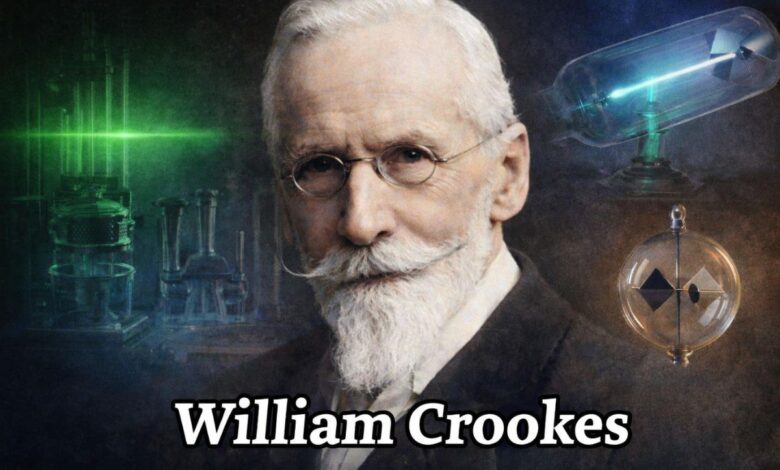
William Crookes remains one of the most fascinating figures in the history of science. Known formally as Sir William Crookes, he was a British chemist and physicist whose work connected the worlds of chemistry, electricity, light, and matter. He is best remembered for discovering the element thallium in 1861 and for his pioneering experiments with cathode rays and vacuum tubes, research that later influenced the development of atomic physics. He was born in London on 17 June 1832 and died there on 4 April 1919.
Crookes lived in a period when science was changing quickly. The 19th century was full of new discoveries, and he was one of the researchers helping to drive that change. His experiments were not only important in their own time, but they also helped later scientists understand the structure of the atom and the behavior of electrons. Because of this, William Crookes is still remembered as an original thinker, an inventive experimenter, and an important name in scientific history.
Early Life and Education
William Crookes was born into a family in London and showed an early interest in science. He studied at the Royal College of Chemistry, where he trained under the strong scientific influence of the age. This education gave him a solid foundation in laboratory work and chemical analysis, skills that would later define his career.
A Young Scientist with Ambition
From the beginning, Crookes was known for being curious and highly practical. He was not only interested in theories but also in instruments, measurements, and experiments. That combination made him especially successful in a century when science depended heavily on careful observation and hands-on testing. His early training prepared him to notice things others might miss, which became clear when he later identified a previously unknown element.
The Discovery of Thallium
One of the greatest achievements in the life of William Crookes was the discovery of thallium. In 1861, while studying the spectrum of selenium compounds, he observed a bright green line that did not match any known element. This unusual signal led him to conclude that he had found something entirely new. He named the new element thallium from a Greek word meaning green shoot or twig, inspired by the vivid green spectral line.
Why This Discovery Mattered
The discovery of thallium was important because it showed the growing power of spectroscopy, a method that allowed scientists to identify elements by the light they produced. Instead of relying only on older chemical methods, Crookes used modern scientific tools to reveal a hidden substance. This helped prove that light analysis could lead to major discoveries. Thallium later became known as a dense and highly toxic metal, but its discovery first made Crookes famous in the scientific world.
William Crookes and Cathode Ray Research
After making his name in chemistry, Crookes moved into physics and the study of electrical phenomena in gases. His work with highly evacuated glass tubes became some of the most influential research of his career. These devices later became known as Crookes tubes. In them, he investigated what happened when electricity passed through gases at very low pressure.
The Road Toward Atomic Physics
Crookes observed that rays seemed to come from the negative electrode, or cathode, and travel in straight lines. He studied how these rays created fluorescence and heating effects. Although his own explanation of the rays was later replaced by more accurate theories, his experiments were a major step toward the eventual discovery of the electron. Scientists after him built on this work to understand subatomic particles and the structure of matter. That is one reason Sir William Crookes is often linked to the early story of modern physics.
Why the Crookes Tube Is Still Remembered
The Crookes tube became one of the key laboratory devices in late 19th-century science. It was not merely a piece of equipment; it was a doorway into a new way of thinking about matter and energy. By making the invisible effects of electricity visible, it helped transform scientific understanding. Even today, the name William Crookes is closely tied to this important instrument.
The Crookes Radiometer and Scientific Creativity
Another invention associated with Crookes is the Crookes radiometer, a glass bulb containing vanes that spin when exposed to light. For many people, this is one of the most visually memorable objects connected with his name. The device captured public imagination because it seemed almost magical, turning light into motion.
More Than a Famous Curiosity
Although the radiometer became popular as a scientific curiosity, it also reflected Crookes’s deep interest in radiant energy, vacuum conditions, and measurement. He did not fully explain the phenomenon the way modern physics later would, but his creation showed how experimental science can inspire both specialists and the general public. It also demonstrated his talent for designing apparatus that could reveal subtle physical effects.
Recognition, Honors, and Influence
William Crookes received major recognition during his lifetime. He was elected a Fellow of the Royal Society in 1863, later served as its President from 1913 to 1915, and was knighted in 1897. These honors reflected the high regard in which his scientific peers held him. He was seen as one of Britain’s leading experimental scientists.
A Scientist with Wide Interests
Crookes did not limit himself to one narrow field. He worked on spectroscopy, rare earth elements, vacuum physics, and other scientific questions. His range made him unusual even in a time filled with gifted researchers. He also had a strong interest in practical science and laboratory technique, which helped his work remain influential across disciplines.
A Complex and Debated Legacy
No article about Sir William Crookes is complete without mentioning that part of his legacy remains controversial. In addition to his work in chemistry and physics, he became interested in spiritualism and investigated mediums. This side of his career has long been debated. Some historians see it as a distraction from his scientific achievements, while others view it as part of a broader Victorian interest in unexplained phenomena.
Why His Reputation Endures
Even with that controversy, Crookes’s reputation in mainstream scientific history remains secure because of the quality and impact of his experimental research. His work on thallium, cathode rays, and vacuum tubes had lasting value. He helped create the bridge between classical chemistry and the emerging physics of particles, radiation, and atomic structure. For that reason, the name William Crookes still appears in textbooks, biographies, and discussions of great scientific pioneers.
Quick Info About William Crookes
Full Name
Sir William Crookes
Born
17 June 1832, London, England
Died
4 April 1919, London, England
Profession
British chemist and physicist
Best Known For
Discovery of thallium, Crookes tube, cathode-ray studies, and Crookes radiometer
Education
Royal College of Chemistry
FAQs About William Crookes
Who was William Crookes?
William Crookes was a British chemist and physicist best known for discovering thallium and for his groundbreaking experiments on cathode rays and vacuum tubes.
What did Sir William Crookes discover?
He discovered the element thallium in 1861 by observing a bright green spectral line.
Why is William Crookes important in physics?
He played an important role in early cathode-ray research, which later contributed to the development of atomic physics and the understanding of electrons.
What is the Crookes tube?
The Crookes tube is a vacuum tube used to study electrical discharge in gases and cathode rays. It became an important tool in the history of physics.
What is the Crookes radiometer?
It is a glass device with spinning vanes that move when exposed to light, often associated with Crookes’s experiments on radiant energy and vacuum effects.
Is “William Crook house” related to William Crookes?
The phrase “William Crook house” appears to be a search variation or misspelling rather than a standard historical term tied to Sir William Crookes. His best-known residence and laboratory were associated with Kensington Park Gardens in London.
Conclusion
William Crookes was far more than a Victorian-era scientist with a famous name. He was an experimental pioneer whose work helped shape the future of both chemistry and physics. From the discovery of thallium to the development of the Crookes tube, his contributions opened new paths for scientific thought. His life shows how one determined researcher can influence generations of scientists to come. Today, whether people search for william crookes, sir william crookes, or even related search terms, they continue to find a figure whose legacy remains powerful, complex, and deeply important in the story of modern science.