Level Crossing Without Gate Sign: Complete Meaning, Risks, and Safety Guide
Understanding the Level Crossing Without Gate Sign
A level crossing without gate sign is one of the most important road warning signs found near places where a railway track and a road intersect without any gate, barrier, or boom. Unlike guarded crossings, this sign indicates that there are no physical restrictions separating motorists from an approaching train. Drivers must rely entirely on their awareness, judgment, and road sense.
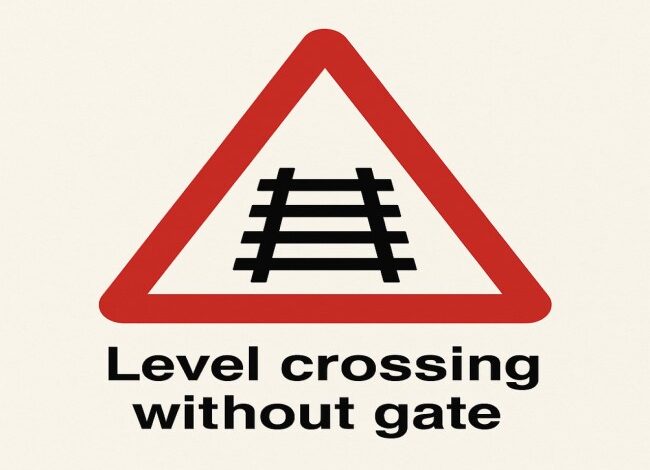
This sign is usually represented as a triangular warning symbol with an image showing tracks or a train, depending on the country. It alerts road users that the upcoming crossing is unprotected, meaning trains may pass with little or no prior mechanical warning. Because of this, the sign plays a critical role in preventing collisions and ensuring maximum safety on both sides of the crossing.
Why the Level Crossing Without Gate Sign Is Important
High-Risk Areas Require Awareness
A crossing without a gate is considered a high-risk environment. Trains cannot stop quickly due to their size, weight, and speed. This means even a small misjudgment from a driver, motorcyclist, cyclist, or pedestrian can result in severe consequences.
No Barriers Means Higher Responsibility for Drivers
Since there are no gates or signals to block vehicles, the responsibility shifts entirely to the driver. The sign works as a warning that the driver must slow down, observe surroundings, and listen carefully for any approaching train.
Prevents Accidents and Saves Lives
Collisions at open level crossings are among the most dangerous because trains move at high speed and have long stopping distances. The presence of this sign encourages road users to behave cautiously, significantly reducing the chance of crashes.
Appearance and Placement of the Sign
Standard Design
Most countries use a triangular sign with a red border. Inside the triangle, there is a symbol showing a railway track, steam locomotive silhouette, or track barriers depending on local standards.
Strategic Placement
The sign is usually placed several meters before the railway line to give drivers enough time to reduce speed. On busy roads, multiple warning signs may be placed at increasing distances.
Visibility and Condition
To ensure road safety, the sign must remain clearly visible both during day and night. Authorities ensure that the sign is clean, not faded, and not obstructed by trees, buildings, or billboards.
How Drivers Should Respond to the Level Crossing Without Gate Sign
Slow Down Immediately
As soon as a driver sees the level crossing without gate sign, they must reduce speed. Open crossings require extra caution because there is no physical barrier stopping vehicles from entering the tracks.
Look and Listen for Trains
Drivers should check both directions for any approaching train. Trains often produce sound signals, but drivers should not rely solely on sound.
Stop if Necessary
If visibility is poor or a train is approaching, stopping the vehicle is the safest action. Unlike guarded crossings, open crossings may not have warning lights or alarms.
Never Try to Race a Train
Attempting to cross before an oncoming train is extremely dangerous. Trains move faster than they appear, and their stopping distance is significantly longer than that of road vehicles.
Risks Associated with Ungated Level Crossings
Limited Visibility
These crossings may be located in areas where trees, buildings, or curves reduce visibility. Drivers must approach carefully.
High Train Speed
Trains at ungated crossings often pass at regular operational speed. Even a minor miscalculation can lead to a serious accident.
Absence of Alarms or Signals
With no gate barriers or electronic alarms, the risk increases because drivers may not realize a train is nearby.
Driver Negligence
Ignoring the sign or failing to check for trains is one of the most common causes of accidents at such crossings.
Safety Tips for Using a Level Crossing Without Gate
Reduce Speed Before Reaching the Tracks
A safe approach speed gives you time to react if a train suddenly appears.
Turn Off Loud Music
Listening carefully is important, as many trains give audible signals such as horns.
Avoid Overtaking
Never attempt to overtake another vehicle near the crossing. It reduces visibility and increases danger.
Cross Quickly and Smoothly
Once you confirm that it is safe, cross without stopping on the railway lines.
Common Locations of Ungated Crossings
Rural and Low-Population Areas
These areas often have low traffic volume, making gate installation less common. However, they still pose significant risks if not approached carefully.
Agricultural Zones
Farm roads frequently intersect with railway lines without gates. Farmers and local drivers rely heavily on awareness.
Developing Regions
Countries with older railway systems or limited safety budgets may have more ungated crossings.
Role of the Sign in Road Safety Education
Helps New Drivers Learn Defensive Driving
In driving schools, instructors emphasise the importance of understanding this sign. Learners are trained to approach such crossings with maximum caution.
Encourages Responsible Road Behaviour
By understanding this sign, road users develop good habits such as slowing down, checking surroundings, and never taking risks near railway tracks.
Essential for Theory Test Preparation
Many licensing exams include questions on this sign because it is crucial for real-life driving safety.
Final Thoughts
A level crossing without gate sign is much more than a simple traffic symbol—it is a powerful warning that drivers must take seriously. It indicates a high-risk zone where road and rail traffic meet without barriers or automatic protection. By paying attention to this sign, slowing down, checking both sides, and crosing only when safe, drivers can prevent tragic accidents and ensure safer journeys for everyone.
This sign plays a vital role in promoting awareness, caution, and responsible driving. Understanding its meaning and following safety guidelines helps protect lives and enhances overall road safety for motorists, pedestrians, and train passengers alike.