How to Hire PHP Developers Who Can Scale High-Traffic Web Applications
Scalability is no longer a luxury it is a foundational requirement. Whether you are building a SaaS platform, an eCommerce giant, or a content-heavy media site, your application must perform reliably even when millions of users hit your servers simultaneously.
While PHP powers a massive portion of the web, not every PHP professional is equipped to build systems that scale. To avoid slow response times and expensive rewrites, you must look beyond basic scripting. This guide outlines how to identify and hire PHP talent capable of engineering for growth.
1. Understanding High-Traffic Requirements
A high-traffic application isn’t just about “lots of visitors.” It’s about concurrency, data volume, and geographic distribution. When thousands of requests occur in the same second, the architecture must be designed for elasticity.
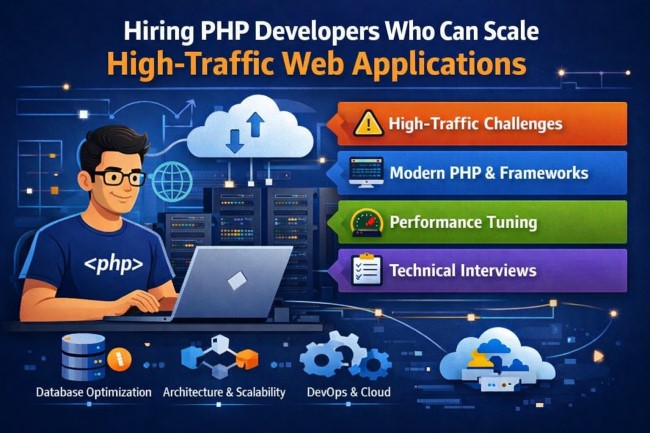
Common High-Traffic Challenges:
- Database Bottlenecks: Heavy read/write operations slowing down the entire system.
- Resource Exhaustion: Memory leaks or inefficient code crashing servers during spikes.
- Session Management: Maintaining user state across multiple distributed servers.
2. Core Technical Competencies to Look For
When you hire PHP developers, you need experts who understand how the engine works under the hood, not just those who can “make it work.”
Modern PHP & Frameworks
The candidate must be proficient in PHP 8.x, leveraging features like JIT (Just-In-Time) compilation, attributes, and union types. While frameworks like Laravel and Symfony provide a solid foundation, a high-level developer knows how to optimize these frameworks rather than relying on default configurations.
Architecture & System Design
Scalability starts with the blueprint. Your ideal hire should be able to navigate:
- Monolithic vs. Microservices: Knowing when to keep things simple and when to decouple services.
- Stateless Design: Ensuring the application doesn’t rely on local server storage, allowing it to scale horizontally.
- Event-Driven Systems: Using message brokers (like RabbitMQ or Kafka) to handle heavy tasks asynchronously.
3. Database and Performance Optimization
The database is usually the first point of failure under load. A developer focused on scalability must be a “data wizard.”
- Relational Mastery: Deep knowledge of MySQL or PostgreSQL, specifically indexing strategies and query optimization.
- Caching Layers: Strategic use of Redis or Memcached to reduce database hits.
- NoSQL Integration: Understanding when to use MongoDB or Cassandra for non-relational data needs.
Key Performance Indicator: Ask candidates how they would identify a “slow query” in a production environment and what steps they would take to refactor it without downtime.
4. The DevOps and Cloud Mindset
Modern PHP doesn’t live on a single dedicated server anymore. High-traffic expertise requires familiarity with the infrastructure.
- Containerization: Using Docker to ensure the “it works on my machine” excuse disappears.
- Orchestration: Experience with Kubernetes for managing auto-scaling clusters.
- CI/CD Pipelines: Automated testing and deployment to ensure that new code doesn’t break the system at scale.
5. Evaluating the Candidates
Resumes can be misleading. To find the top 1% of PHP developer, use a multi-layered evaluation approach:
The Interview Strategy
| Focus Area | Question Type | What to Look For |
| Problem Solving | “How would you handle a 10x traffic spike in 10 minutes?” | Mentions of horizontal scaling, caching, and rate limiting. |
| Technical Depth | “Explain the difference between PHP-FPM and Swoole.” | Understanding of process management and asynchronous PHP. |
| Past Experience | “Tell me about the largest user base you’ve managed.” | Specific metrics (Requests per second, DAU, etc.). |
6. Choosing the Right Hiring Model
Depending on your stage of growth, your hiring strategy may vary:
- In-House Developers: Best for long-term product evolution and deep domain knowledge.
- Freelancers: Ideal for short-term bursts or specific optimization tasks.
- Agencies: Best for rapidly scaling a full team with pre-established workflows.
Conclusion
Hiring PHP programmer for high-traffic environments requires looking past the surface. You need architects, performance enthusiasts, and engineers who prioritize stability as much as features. By focusing on database proficiency, modern architectural patterns, and cloud-native practices, you can build a team that doesn’t just keep the lights on, but helps your business grow.